

There are surfaces we recognise before we consciously understand why: a stone stair rounded by thousands of footsteps, a wooden handrail polished where generations of hands have held it, or a piece of fabric whose weave feels familiar enough to make us want to touch it before we have even decided whether we like its colour.
Materials accumulate memory. Some of that memory is physical—scratches, erosion, compression, polish—and some of it is cultural. We learn what materials are supposed to feel like and how they are expected to behave. Marble is cold and permanent, timber is warm and fibrous, fabric gives way beneath the hand. Design becomes particularly interesting when these expectations begin to shift.
What if stone could carry the memory of carved timber? What if marble could suggest the irregularity of skin? What happens when a familiar material begins to behave in an unfamiliar way? These questions sit behind my Tactile Experiments: Carved Stone Studies, a small series developed less as finished products and more as material questions made physical.
We experience surfaces with more than our eyes
Architecture and objects are increasingly encountered through images. We scroll through polished interiors, perfectly lit objects and immaculate material samples, sometimes without ever touching the things we are looking at. Physical materials resist this reduction.
A rough surface breaks light differently from a polished one. Deep relief creates shadows that shift as we move past it. An uneven edge invites the hand to investigate. Texture, temperature and friction all become part of the experience. This is why two surfaces made from exactly the same stone can feel like completely different materials.
A polished slab communicates stillness. Carve the same slab repeatedly and it gains rhythm, direction and movement. Texture is therefore not simply decoration applied to a surface; it changes the way we understand the material itself. Some surfaces ask to be looked at, while others almost insist on being touched.
Learning from Naguri
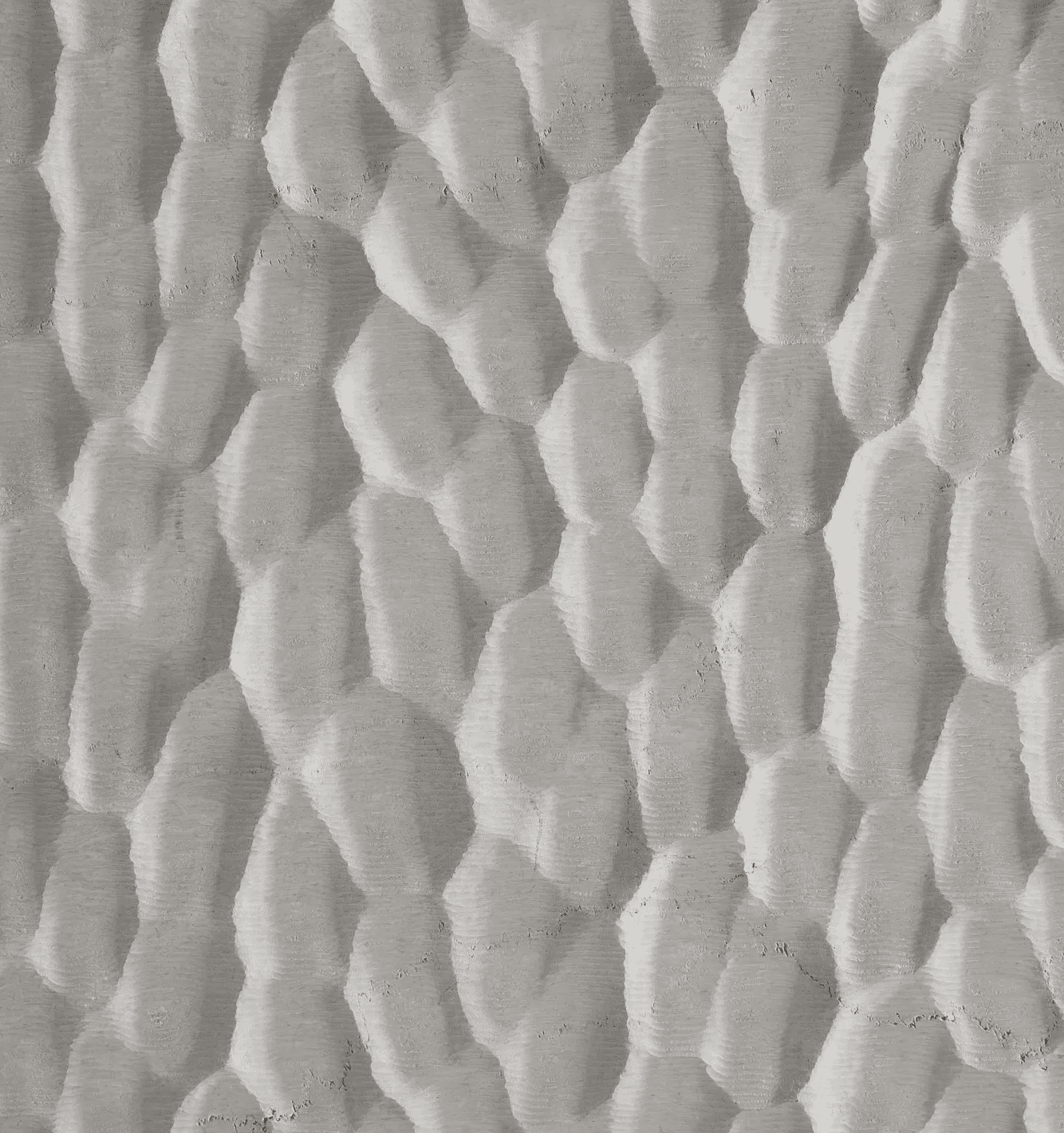
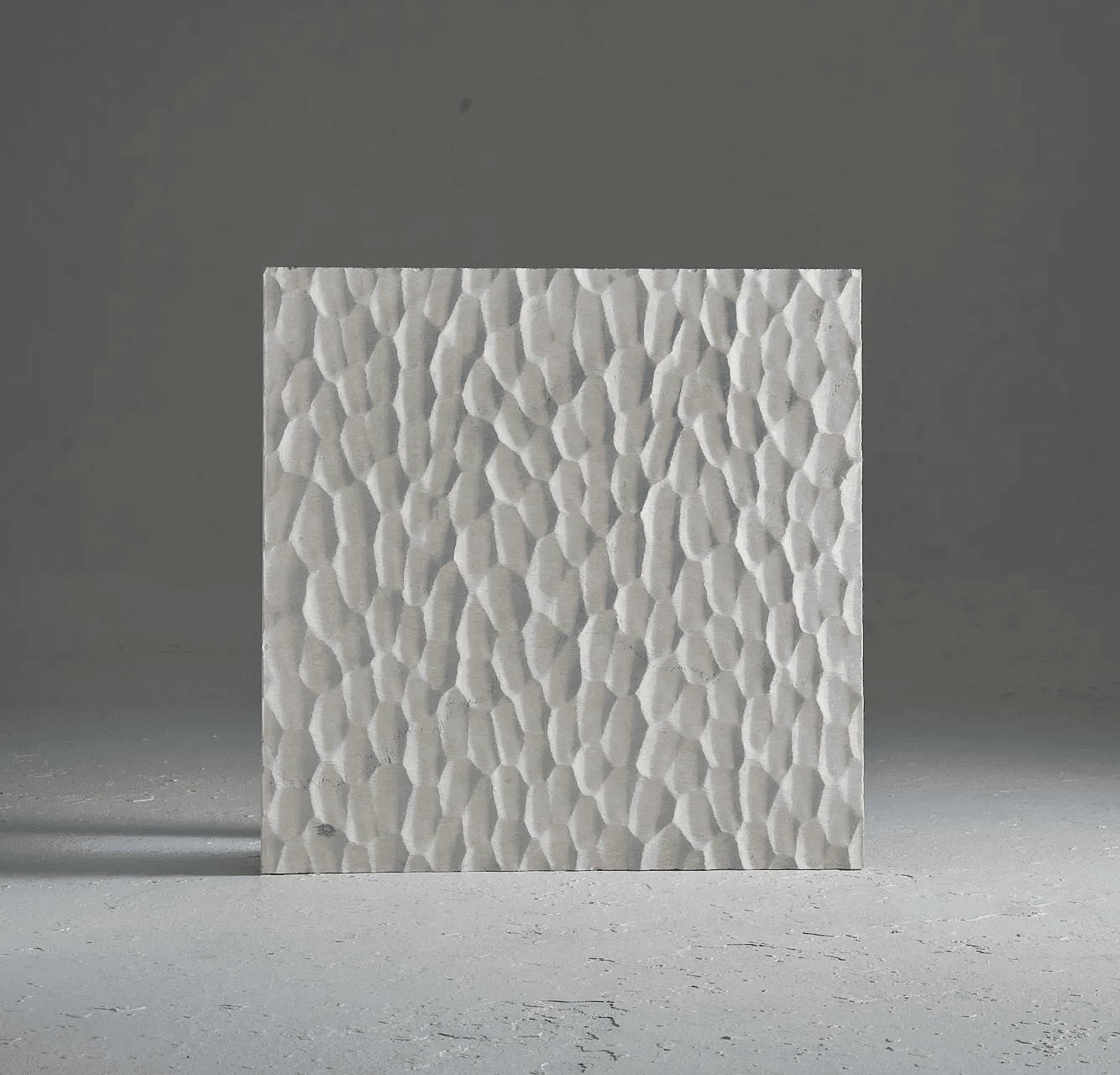
One of the studies began with Naguri, a Japanese woodworking approach in which timber surfaces are deliberately shaped through repeated carving. What interests me about Naguri is not simply its recognisable appearance, but the logic beneath it. Individual tool marks remain visible, yet together they create rhythm. Repetition provides order while small variations prevent the surface from feeling mechanical.
Translating this into stone was never about making marble look like timber. I was more interested in what could be learned from the process: repetition without perfect sameness, direction created through carving, depth revealed by grazing light, and the ability of many small interventions to completely transform a surface.
The resulting study does not reproduce a particular Naguri pattern. It carries a memory of its logic. This distinction matters when traditional craft becomes a reference for contemporary design. Tradition is often most useful as a source of principles rather than as a catalogue of forms.
Traditional techniques contain knowledge about much more than appearance. They tell us how tools meet materials, how repetition accommodates imperfection, how surfaces age, how light reveals workmanship and how the body encounters an object. These lessons can survive even when the original visual language disappears. A woodworking technique might inform CNC-milled stone; a textile process might influence cast glass. The outcome does not need to look traditional in order to learn from tradition.
Nature does not repeat perfectly
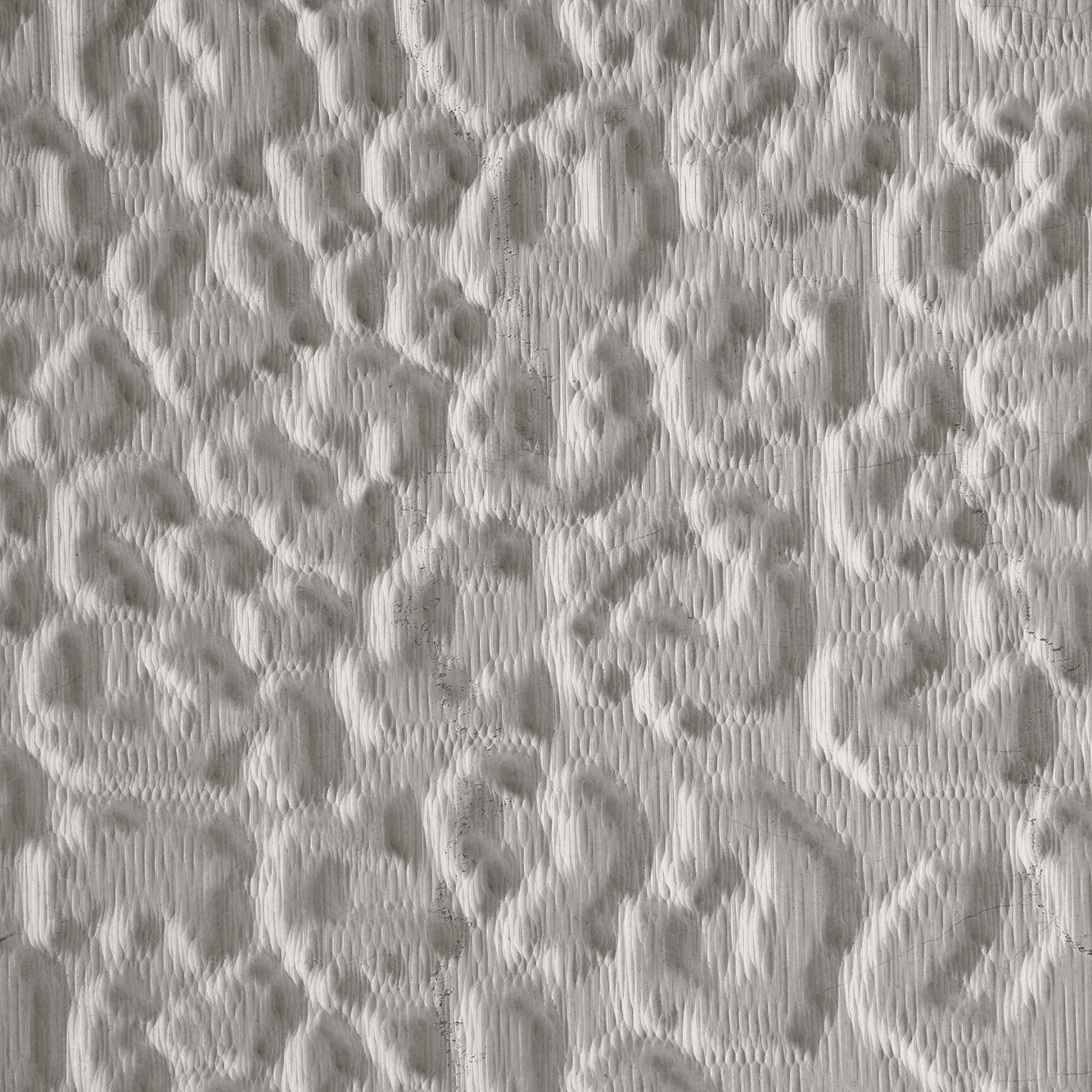
The second study started somewhere very different: the patterning of leopard skin. What interested me was not the image of the animal itself, but the organisation of its surface.
From a distance the pattern appears repetitive, yet closer inspection reveals that almost nothing repeats exactly. Some marks gather, others separate, and empty areas are as important as dense ones. There is enough consistency for the eye to recognise a system and enough variation to keep that system alive.
Nature is remarkably good at this. Designed patterns often reveal their repeat quickly; once we recognise the module, the surface can become predictable. Natural patterns behave more like systems governed by rules than collections of identical copies. Translating this quality into stone meant resisting the temptation to make everything too clean. The irregularity is part of the design.
This becomes particularly relevant in an age of digital fabrication. CNC machining allows extraordinary consistency, but precision raises another question: just because every element can be identical, should it be? Variation can now become a deliberate design decision rather than an unavoidable consequence of hand production. A pattern can deform gradually, relief depth can change across a surface, or several related modules can replace one endlessly repeated unit. This is not about pretending machine production is handmade; it is about recognising that absolute uniformity is only one possible aesthetic.
Why material experiments matter
There is often pressure in design to justify every exploration immediately. What is it? Where will it be used? How will it be produced? Who will buy it? Those questions matter, but asking them too early can narrow an experiment before it has taught us anything.
Sometimes a material study begins simply because you want to understand how shadow behaves at a particular depth. You repeat a mark until it stops feeling like a mark and becomes texture. You push a relief too far, discover that the mistake is more interesting than the original intention, and begin again.
This is not wasted work. Material experiments build a vocabulary that can later appear somewhere completely different: a wall panel, a piece of furniture, an interior or a detail that nobody consciously notices. Research does not always need to produce an object. Sometimes it changes the way the next object is designed.
The most interesting moment comes when a small experiment begins to suggest a larger architectural application. A carved texture can become a wall; at that scale, the surface no longer responds only to the hand but to the movement of a person through space. A pattern might become denser near an entrance and gradually dissolve, or relief might deepen where natural light grazes the surface. Several panels could follow the same underlying rule while remaining individually different.
At that point, texture stops feeling like something placed onto stone and begins to emerge through a conversation with the material.
Designing for the hand
Perhaps the simplest lesson is the most important: people touch things.
We run our hands along walls, notice the edge of a table and instinctively investigate materials whose appearance we cannot immediately understand. That desire to touch is one of our most basic relationships with objects, yet it can easily disappear from a design process dominated by screens.
Material experimentation brings it back. It reminds us that the success of a surface cannot always be judged from an elevation or a photograph. Sometimes you need to approach it, move beside it, watch the shadow change and eventually put your hand on it. That small moment of physical curiosity can create a connection that an image cannot fully reproduce.
The two pieces in Tactile Experiments are deliberately modest studies rather than finished collections. One begins with the accumulated knowledge of a traditional woodworking practice; the other with a pattern produced without any designer at all. Both eventually arrive at stone, and both ask the material to carry the memory of something it has never physically been.
Perhaps that is what material experimentation can do at its best. It does not simply invent another surface. It creates unexpected relationships between things we already know—and sometimes, by changing the surface of a familiar material, changes the way we understand the material itself.