

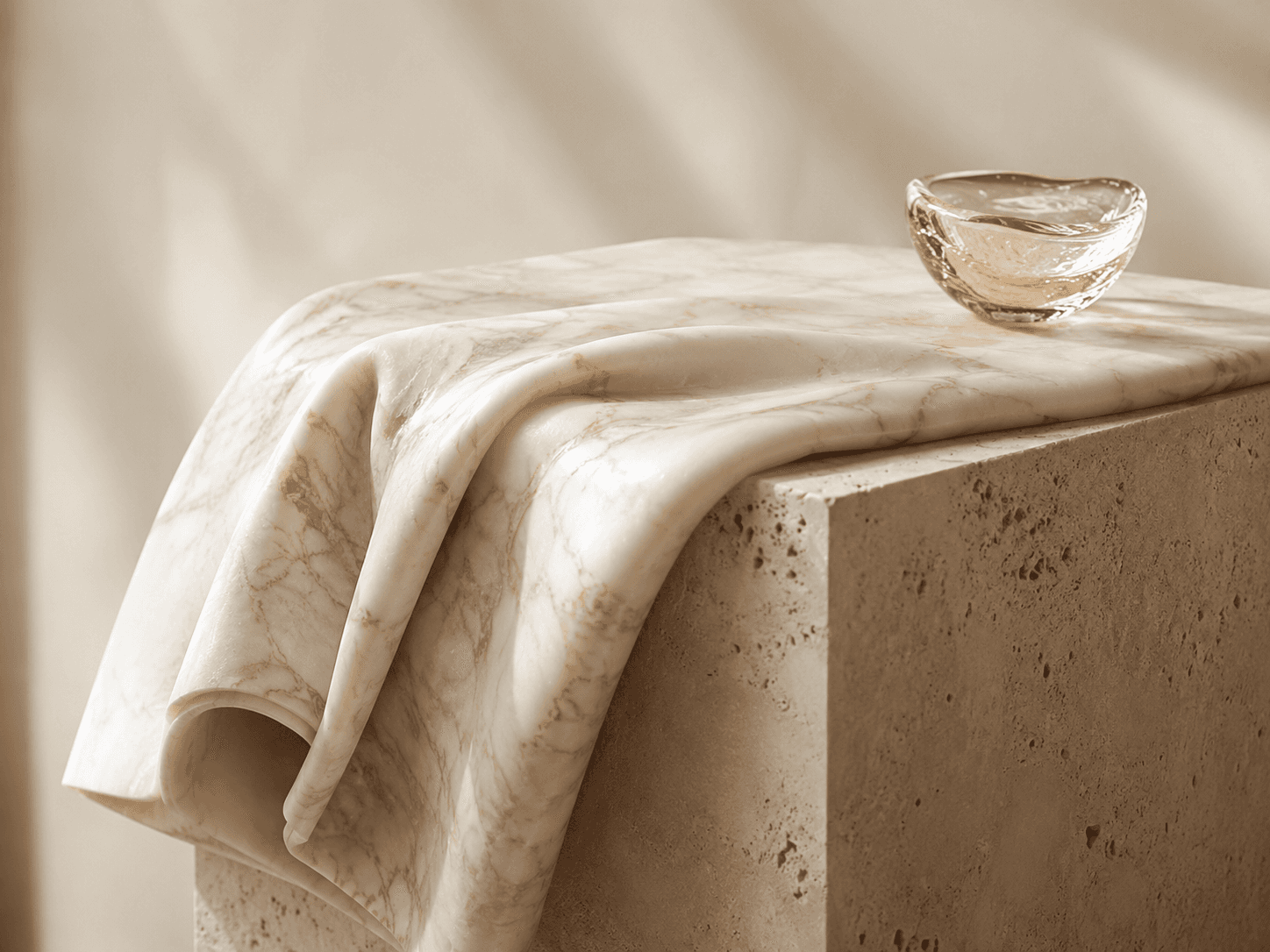
Stone cannot fold. Glass cannot drape. Marble cannot inflate like a cushion.
Yet contemporary objects and surfaces increasingly ask hard materials to suggest precisely these qualities. Stone is carved into folds, glass appears suspended in motion, and rigid volumes take on the softness of fabric, skin or upholstery.
The attraction lies in the contradiction. We understand the physical weight, temperature and permanence of these materials, but their forms communicate something different. The eye recognises softness while the mind knows that the object remains solid.
This tension encourages us to look more closely and reconsider what a familiar material is capable of expressing.
Softness as a visual quality
Softness is usually understood through touch: how a material bends, compresses or responds to the body. In design, however, softness can also be visual.
Rounded edges, gradual transitions and compressed volumes can make a rigid object appear gentle or fluid. Repeated folds may suggest fabric, while a shallow depression can imply pressure against a cushioned surface. Light moving across a curved form can give solid material a sense of motion.
These objects do not physically behave like textiles, but they carry a visual memory of them.
Materials also arrive with established expectations. Marble suggests permanence and weight; glass suggests fragility and transparency; metal suggests strength and precision. When these materials appear to behave against their nature, their physical qualities become even more noticeable.
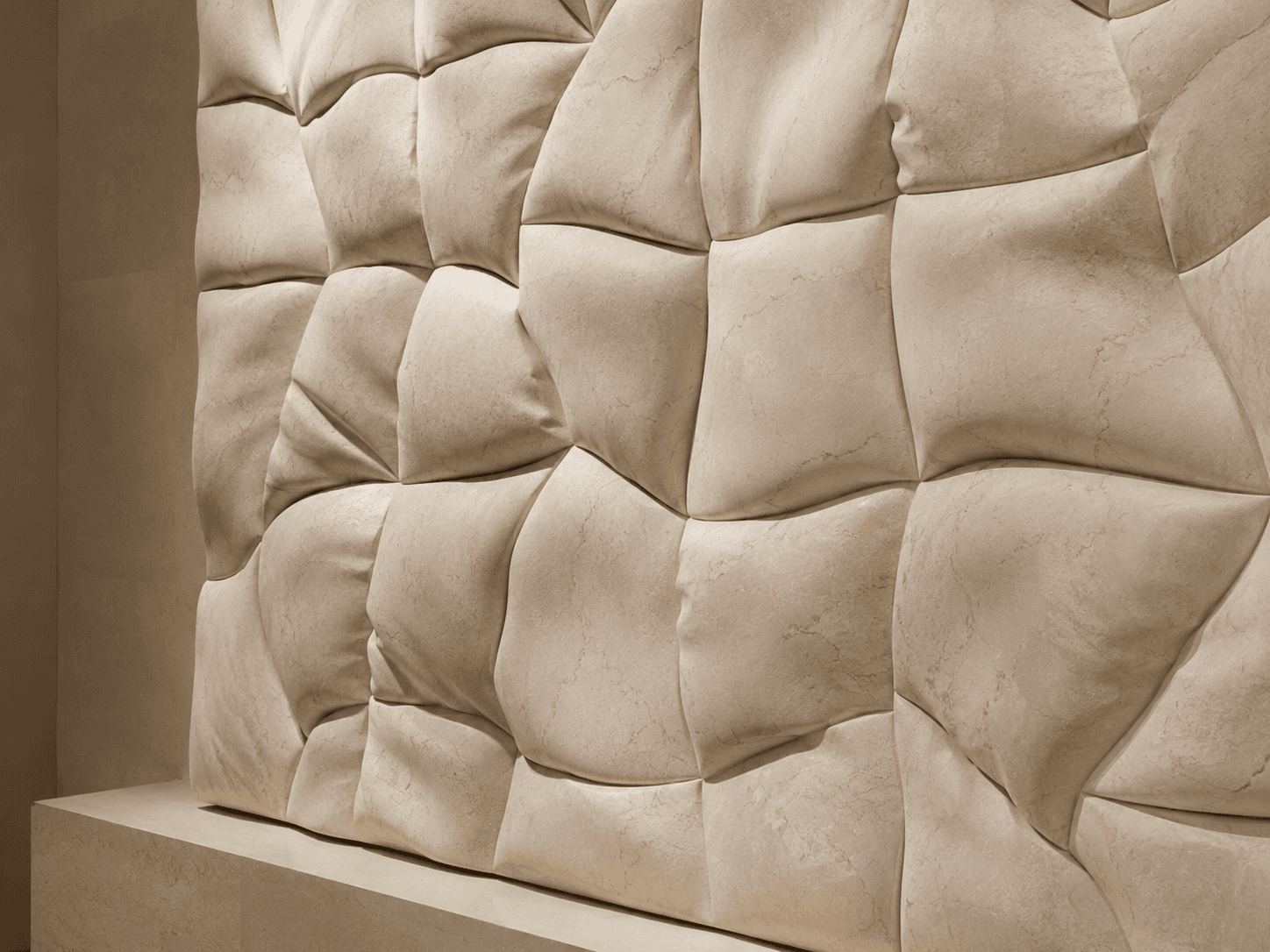
A marble surface that looks quilted does not conceal the hardness of stone. Instead, its apparent softness makes that hardness more present. The contradiction becomes the central experience of the design.
Movement held in material
Textiles gather, fall and change according to gravity, pressure and movement. A fold records a force: where fabric has been stretched, compressed, suspended or allowed to settle.
Translating these behaviours into stone or glass gives movement a permanent form. The object may feel like a frozen moment—a surface captured while shifting or a volume held just before it settles.
This creates a relationship between two different experiences of time. Textile is temporary and responsive, while stone is slow and enduring. Bringing them together allows a passing gesture to be preserved within a material associated with permanence.
The objective is not to make stone convincingly imitate fabric. Literal reproduction can quickly become theatrical. A stone surface does not need carved stitches or seams to communicate textile qualities.
A more considered approach begins by studying behaviour. Where does fabric gather? Which areas remain smooth? How does tension shape the surface? How does light reveal the depth of a fold?
These observations can then be translated rather than copied. A quilt may become a rhythm of raised and recessed volumes. A draped garment may inform the curved profile of a glass shade. Upholstery may be reduced to a subtle compression around the edge of a solid form.
The reference remains present, but it is transformed through the logic of another material.

Satin: the memory of quilting in stone
My Satin wall panel began with traditional Anatolian quilt-making and vernacular textile patterns.
Rather than transferring a historic motif directly onto stone, I focused on the physical qualities associated with quilting: repetition, compression, softness and the gradual movement between raised and recessed areas.
The resulting natural stone relief appears padded, although its surface is entirely rigid. Light travels across the folds, changing the perceived depth and rhythm of the pattern throughout the day.
The weight of stone remains visible, but it is balanced by a surface language associated with touch and handcraft. Satin treats natural stone not as a static wall finish, but as a tactile architectural experience shaped by texture, shadow and cultural memory.
Chiton: translating drapery through glass and stone
The Chiton collection takes its name from the ancient Greek garment known for its fluid fall around the body.
Here, the reference emerges through movement rather than ornament. Curved glass shades recall the lightness and drape of fabric, while natural stone bases introduce weight and permanence.
Glass allows light to move across the form, making its curves appear less fixed. Stone acts as a grounded counterpoint. The relationship between the two materials reflects the balance between a garment and the body that supports it.
Chiton does not reproduce ancient clothing. Instead, it translates its rhythm and behaviour into a contemporary collection of sculptural lighting and objects.
Both Satin and Chiton begin with textiles, but they lead to different outcomes. Satin captures compression and repetition in a solid architectural surface. Chiton explores drape, transparency and movement through glass and stone. The source may be similar, but each material determines a different form.
Digital craft and impossible folds
Digital modelling and CNC fabrication have expanded the ways hard materials can be shaped. Complex curves can be studied before production, transitions can be refined with precision, and repeated reliefs can become modular architectural systems.
This does not remove craft from the process. It changes where craft occurs.
The designer must still understand material thickness, fabrication limits, structural requirements, surface finishing and the way light will reveal the final geometry. Digital tools may make certain forms possible, but material knowledge determines whether they become convincing objects.
Technology is most valuable when it does more than demonstrate technical ability. It should enable a material to communicate something that would otherwise remain difficult to express.
The most successful results retain a sense of the material’s nature. Stone should still feel dense and mineral; glass should remain connected to transparency and light. Softness becomes an additional quality rather than a disguise.
Between what an object is and what it appears to be
When stone looks like fabric, it occupies two realities at once.
It is physically rigid but visually flexible. It is heavy but may appear light. It is permanent, yet its form suggests a passing movement.
This ambiguity creates a more active relationship between the object and the viewer. We do not simply identify the material; we compare what we know with what we see.
Hard materials do not truly become soft. But by allowing them to carry the memory of folds, compression and movement, design can reveal unfamiliar qualities within materials we thought we already understood.
The objective is not to make stone forget that it is stone. It is to discover how much more stone can express.