

The past offers more than forms to reproduce. It carries ideas, rituals, materials, and ways of making that can be translated into new design languages.
Historical references are often visible in contemporary interiors, furniture, and objects. Yet there is a significant difference between using the past as a source of knowledge and treating it as a catalogue of decorative motifs. One produces continuity; the other risks becoming imitation. For me, the most interesting references are not necessarily the most recognisable ones. A project does not need to reproduce an ancient column, traditional pattern, or historic silhouette to carry cultural memory. The reference may instead emerge through a material relationship, a method of construction, a social function, or the way a surface responds to light.
The objective is not to recreate a previous period. It is to understand what made a particular object, structure, or tradition meaningful—and to consider how that underlying idea might take shape today.
Looking beyond appearance
When studying a historical reference, form is often the most immediate element. It is also the easiest to copy. A more considered design process begins by looking beyond appearance. Why was something made in a particular way? Which materials were available? What function did it perform? What did it communicate about the society that produced it?
These questions allow a reference to be separated from its original visual language. Once its essential qualities are understood, they can be reinterpreted through contemporary materials, technologies, and contexts. This creates a form of continuity without requiring direct reproduction. The resulting work can feel connected to the past while remaining unmistakably contemporary.
Satin: translating textile memory into stone
Satin takes its starting point from traditional Anatolian quilt-making and vernacular textile patterns.
Rather than transferring a historical motif directly onto a stone surface, the design studies the physical qualities of quilted fabric: compression, softness, repetition, folds, and the rhythmic movement created by handcraft. These characteristics are translated into a sculptural natural stone wall relief. The contradiction between the visual softness of the surface and the inherent weight of stone becomes central to the design.
Satin does not attempt to make stone imitate fabric literally. It uses the memory of textile to reconsider how stone can be perceived—less as a static cladding material and more as a tactile surface shaped by rhythm, depth, light, and shadow.

Chiton: movement held in form
The Chiton collection is named after the ancient Greek garment defined by its fluid drape and natural fall around the body.
Here, the reference is not a decorative symbol but a behaviour. The way fabric gathers, curves, and responds to movement becomes the basis for a collection of sculptural lighting and objects. Curved glass elements evoke the lightness and translucency of fabric, while natural stone introduces weight and permanence. The contrast between the two materials reflects the relationship between the moving garment and the body that supports it.
The collection does not reproduce ancient dress. Instead, it translates its movement and rhythm into a new material composition.
Aegen: pattern as cultural memory
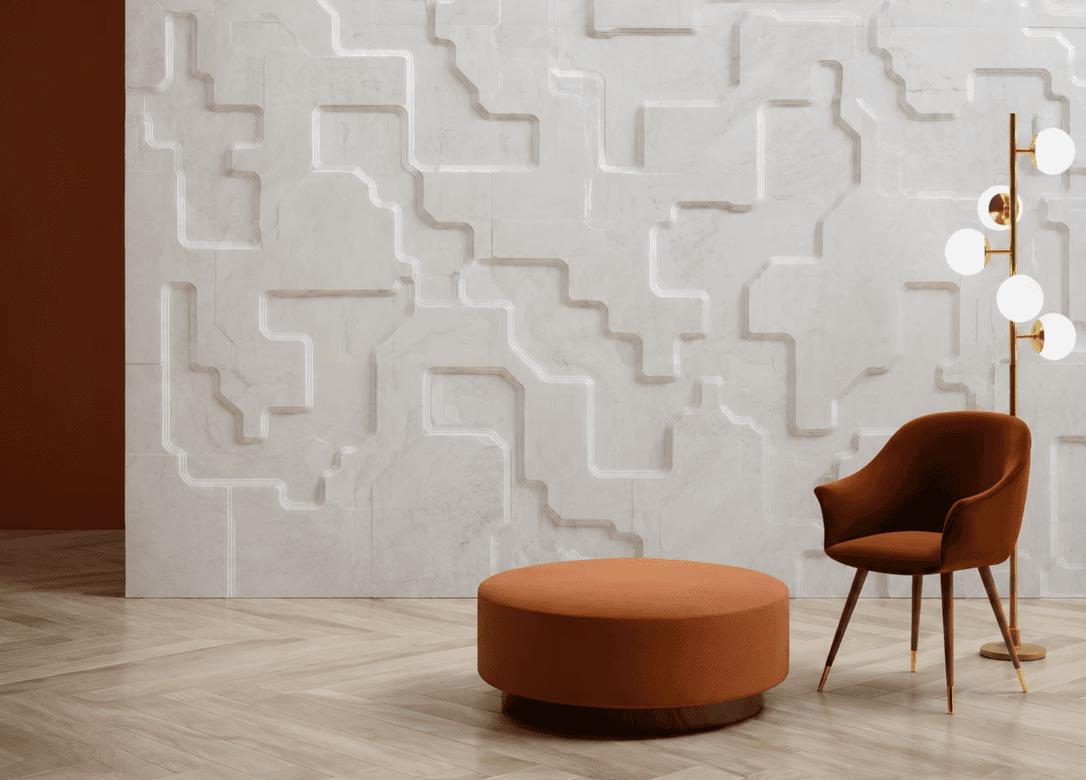
Aegen explores the visual and architectural memory of the Aegean region through a modular natural stone relief system.
The design draws from geometric structures found across historic architecture and decorative arts, but avoids reproducing a single identifiable pattern. Individual modules interlock to create a continuous surface that can adapt to different architectural dimensions. This modularity allows the reference to operate as a system rather than an ornament. The panel becomes both a sculptural feature and a repeatable architectural element, produced through contemporary digital fabrication.
Aegen treats historical geometry as an evolving language—one that can be reorganised, abstracted, and extended rather than simply preserved.
Mercy: translating care into architecture
Mercy began with the birdhouse tradition found in Turkish and Ottoman architecture. Historic birdhouses were integrated into the façades of mosques, houses, inns, and other structures, providing protected nesting spaces while forming part of the wider architectural composition. The project does not recreate the miniature palaces and ornamental structures associated with many surviving examples. Instead, it focuses on the principle behind them: the idea that architecture can provide shelter for species beyond its human occupants.
Mercy translates this culture of care into a modular natural stone façade system. Nesting spaces are carved directly into the architectural surface using contemporary CNC production methods. The historical reference therefore remains present, but not as a copied form. It survives through function, material, and intention.
Designing through translation
Referencing the past is ultimately an act of translation.
Every translation involves interpretation. Certain qualities are preserved, others are removed, and new relationships are introduced. Material, scale, function, and production method all influence the final outcome. This process requires both respect and distance. Respect is necessary to understand the context and significance of a reference. Distance is equally important, allowing the designer to question it, transform it, and give it relevance beyond its original setting.
Historical references become most valuable when they help produce something new. They can offer depth without nostalgia, familiarity without repetition, and continuity without limiting contemporary expression. The past should not determine the final form of a project. It should provide a foundation from which another form can emerge.